
June 22, 2026
Toward a New Era of Astronomy: A New Step in Multi-Messenger Astronomy at Cosmological Distances - Gravitational Lensing Reveals a Connection Between Intense Star Formation 11 Billion Years (TI-FRIS Fellow Prof. Shigeo Kimura)
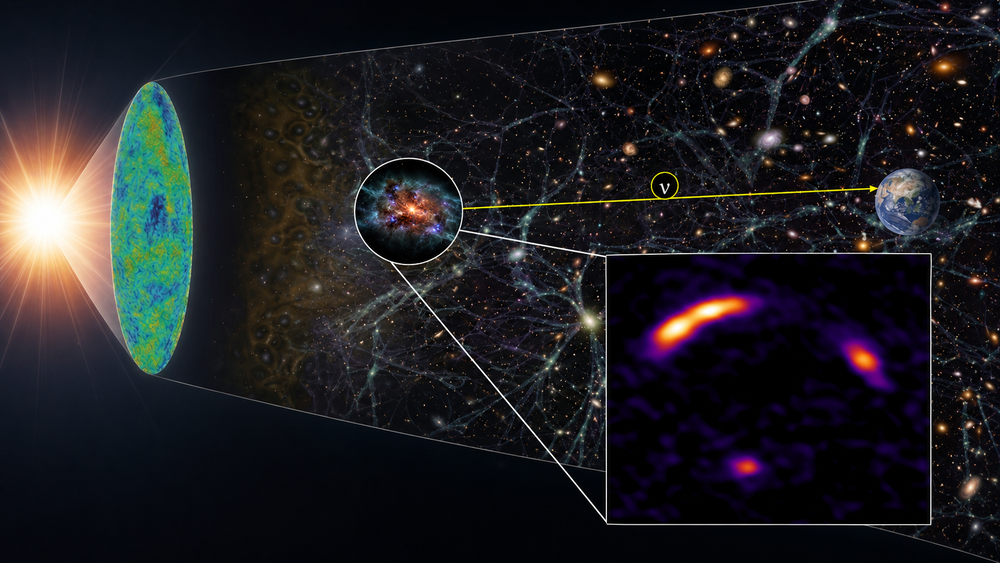 Figure: A conceptual figure of this study. The background diagram represents the history of the Universe stretching from the Big Bang on the left and the modern Universe on the right. ALMA captured the starburst galaxy “Shadow Blaster” in the same direction as the high-energy neutrino event IC 210922A. Actual radio observations by ALMA are shown in the zoom-in inset. Due to gravitational lensing, the ALMA observations show four distorted images of Shadow Blaster, which has been identified as the source of the neutrinos (indicated by the Greek letter nu). An artist’s conception of Shadow Blaster’s true appearance is shown in the circle. (Credit: MITOS)
Publication Details:
Title: Compact dusty starbursts at cosmic noon linked to high-energy neutrinos
Authors: Yuji Urata*, Kuiyun Huang*, Bunyo Hatsukade, Mansi Kasliwal, Shigeo, S. Kimura, Yuichi Matsuda, Yusuke Miyamoto, Hiroshi Nagai, Kouichiro Nakanishi, Robert Stein
Journal: Nature Astronomy
DOI: 10.1038/s41550-026-02884-9
